
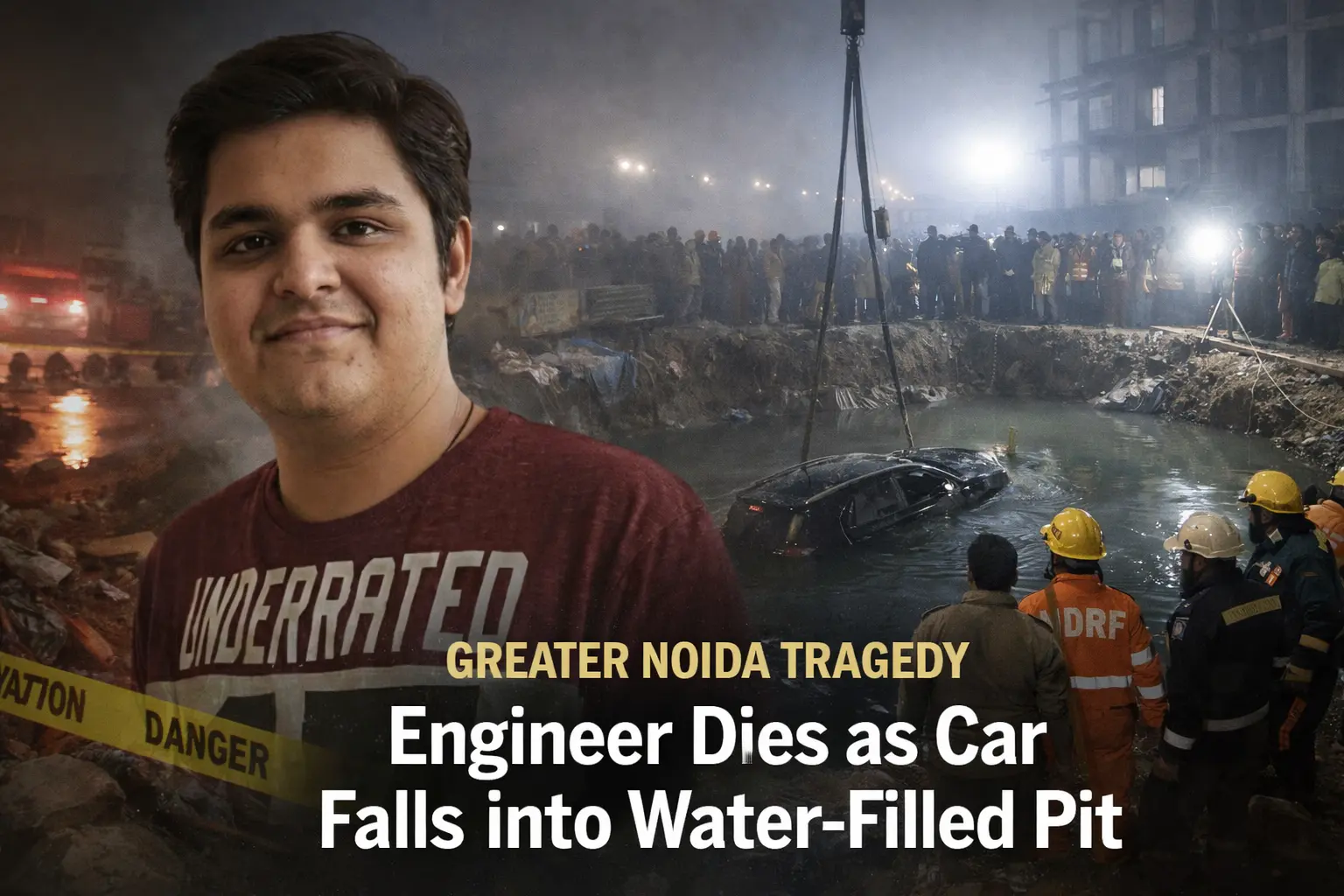
Greater Noida (UP), January 19, 2026 – In a tragic late-night accident that has sparked widespread outrage and raised serious questions about construction safety and emergency preparedness, a 27-year-old software engineer lost his life after his car veered off the road and plunged into a deep water-filled pit in Sector 150 of Greater Noida.
The victim, identified as Yuvraj Mehta, was returning to his home in Tata Eureka Park society from his office in Gurugram when the fatal incident occurred around midnight on Saturday, January 17. According to police and eyewitness accounts, poor visibility due to dense fog and the absence of proper safety barriers at the site were major factors in the tragedy.
A Desperate Struggle in the Dark
Mehta’s vehicle, a Maruti Suzuki Grand Vitara, lost control near an under-construction commercial plot, reportedly around 20 to 30 ft deep, that had been left open for excavation of the basement. The car reportedly broke through a damaged boundary wall or drainage barrier and fell into the pit filled with stagnant rainwater.
According to multiple news reports, Mehta managed to exit the vehicle and climb onto the roof as the SUV began to sink. He repeatedly used the torchlight on his mobile phone and cried for help in the freezing water, with moments captured in emergency calls to his father, who rushed to the scene after being notified by his son. Mehta reportedly told his father, “I don’t want to die, please save me,” before his voice faded.
Despite the desperate pleas and efforts by a passing delivery agent who himself jumped into the pit in an attempt to assist, rescue efforts were hampered by the cold water, dense fog and submerged hazards, according to eyewitnesses and family members.
Rescue Efforts and Their Limitations
Local police received the first information about the accident at around 12:15 a.m. from residents who heard cries and observed the submerged vehicle. A coordinated rescue operation was mobilised, involving teams from the fire department, State Disaster Response Force (SDRF), National Disaster Response Force (NDRF) and local police.
However, rescue teams reportedly encountered severe challenges:
- Near-zero visibility due to dense fog.
- The icy temperature and deep, stagnant water, making it difficult for personnel to enter without specialized diving equipment.
- The presence of construction debris and iron rods beneath the water’s surface, which posed additional risk to responders.
Multiple agencies worked until around 4 a.m. before Mehta’s body was finally recovered and taken to Kailash Hospital in Knowledge Park, where he was declared dead. The body has since been sent for post-mortem examination.
According to preliminary findings and the post-mortem, Mehta’s death resulted from asphyxiation and heart failure, as he struggled in the submerged vehicle and cold water after the crash.
Outrage, Protest and Allegations of Negligence
The accident has triggered an emotional response from both residents and civic activists. Local inhabitants of Sector 150 staged protests, accusing the Noida Authority and the responsible developers of negligence. They allege that complaints about the open pit and inadequate safety measures — including lack of barricades, reflectors and warning signage — had been repeatedly lodged but went unaddressed.
One resident said: “We had requested the Noida Authority several times to take preventive measures, but no action was taken. This accident could have been prevented if proper safety protocols were followed.”
Adding to the controversy, reports indicate that a similar mishap involving a truck occurred at nearly the same spot just days before, nearly costing another life; the driver survived, but no permanent safety improvements were made.
Official Responses and Legal Action
In response to the family’s complaint, police have registered an FIR against two real estate developers whose plot borders the dangerous excavation site. Charges reportedly include culpable homicide and causing death by negligence.
Further administrative action has followed, with the Noida Authority terminating a junior engineer associated with traffic safety in the area and issuing show-cause notices to other officials for potential lapses in safety oversight. The Authority’s CEO, Lokesh M., has reportedly ordered a comprehensive safety review of ongoing construction activities in the region to prevent similar tragedies.
Police officials, while expressing condolences, have defended rescue efforts, emphasising that difficult conditions such as zero visibility and hazardous submerged terrain constrained their ability to enter the water quickly. “All available resources were deployed at the scene, including cranes, boats and searchlights,” a senior officer stated, while affirming that the investigation is ongoing.
Broader Concerns: Urban Planning and Safety Standards
The death of Yuvraj Mehta has reignited broader discussions about urban infrastructure safety, especially in rapidly developing peri-urban corridors like Greater Noida. Experts and residents alike argue that construction sites in mixed residential zones should be rigorously monitored for compliance with safety regulations, including mandated fences, lighting, barricades, and hazard signs — particularly in areas where public roads run adjacent to deep pits or excavation zones.
Activists have also highlighted the need for a more robust emergency response framework that includes mandatory deployment of trained divers or specialized rescue teams when water hazards are involved, to avoid repetition of such tragedies in future.
Community Grief and Calls for Accountability
For Yuvraj’s family, particularly his father who witnessed his son’s final moments, the incident has been a devastating blow both emotionally and financially. Residents and protestors are demanding not only administrative accountability but also compensation for the bereaved family and systemic reforms.
As Greater Noida continues to expand as a residential and commercial hub, this incident serves as a grim reminder of the consequences of ignoring safety protocols in urban development. The tragedy has not only left a family shattered, but also a community demanding answers and systemic change.